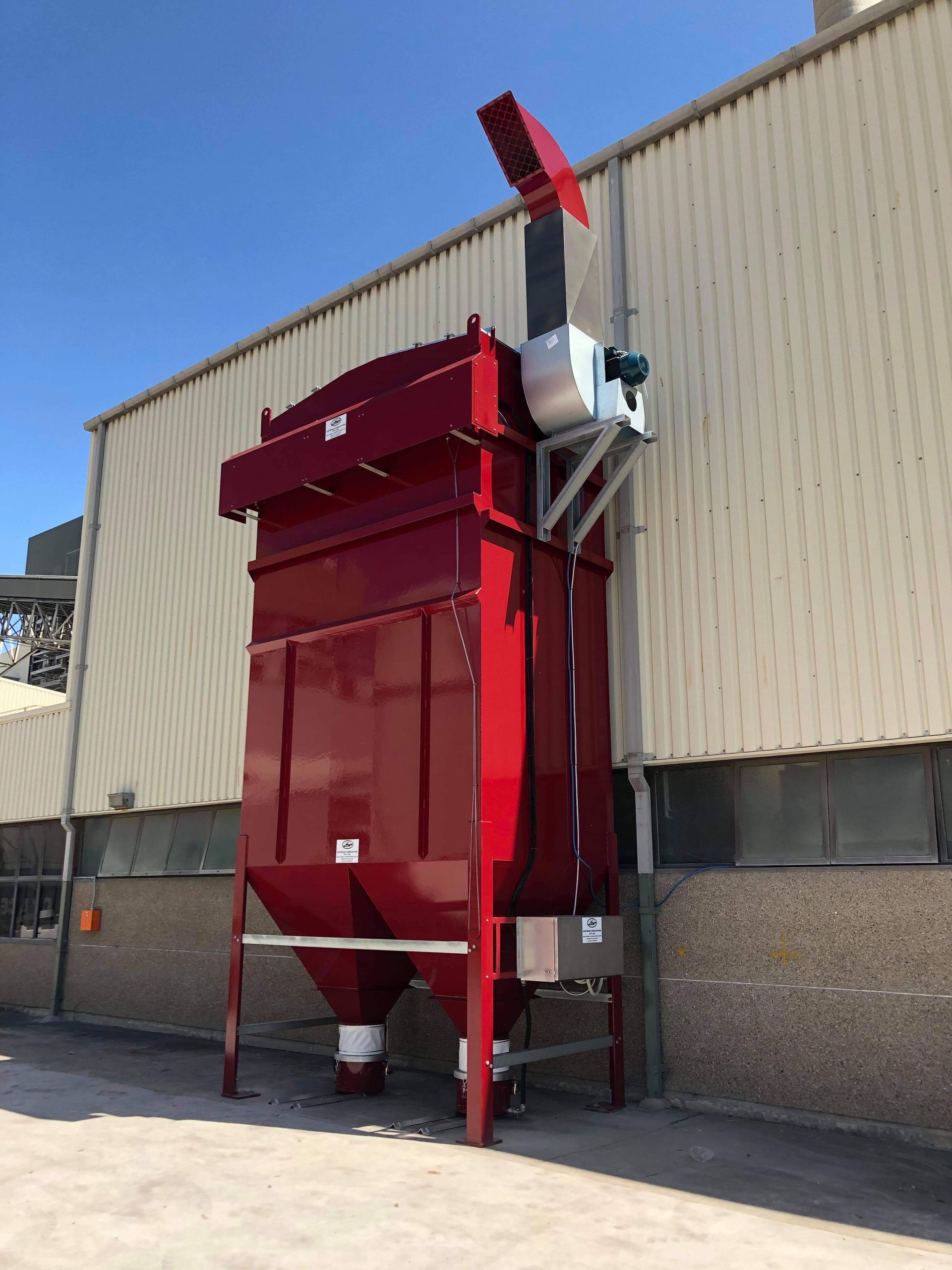
Dust Collector Sizing: Airflow, Capture Velocity, Ducting
To size a dust collector, choose a capture velocity for each pickup point, convert it to an airflow, then size the ducting to carry the combined flow fast enough to keep dust moving. That combined airflow is what your dust extraction system must deliver against the resistance of the hoods, ducting and filters. Dust type and hazards can change every figure.
Key Takeaways
- Capture velocity is the air speed needed at the dust source, and it depends on how the dust is released.
- A hood close to the source needs far less airflow than one placed further away.
- Duct diameter follows from the airflow and the transport velocity, commonly 15 to 20 m/s for dry dust.
- The collector must deliver the combined airflow of every branch running at once.
- Dust type, moisture and combustibility can change these figures.
How much airflow does each extraction point need?
Each hood, downdraft table or extraction arm needs enough air to pull dust in against room draughts, and the amount depends on the capture velocity: the air speed needed where the dust is released.
The ranges commonly quoted from the Industrial Ventilation manual of the American Conference of Governmental Industrial Hygienists (ACGIH) are:
- Released with almost no speed into still air: about 0.25 to 0.5 m/s.
- Released at low speed into moderately still air: about 0.5 to 1.0 m/s.
- Generated actively into fast-moving air: about 1.0 to 2.5 m/s.
- Thrown off at high speed into very rapid air movement, as in grinding: about 2.5 to 10 m/s.
Use the upper end of a range where there are cross-draughts, the dust is more hazardous or the process runs continuously. For a plain hood, airflow is Q = Vc × (10x² + A), with Q in m³/s, Vc the capture velocity in m/s, x the distance from the hood face to the source in metres and A the face area in m². A wide flange cuts the airflow by about a quarter.
How do you size the duct diameter?
Divide the airflow by the transport velocity, the air speed that keeps dust suspended in the duct, to get the cross-sectional area, then convert that to a diameter: D = √(4Q ÷ (π × v)), with D in metres, Q in m³/s and v in m/s.
Commonly used starting points are:
- Welding and other fumes: about 10 to 13 m/s.
- Dry powders and general industrial dust, such as grinding dust: about 15 to 20 m/s.
- Heavy dust, such as metal turnings, and damp dust: 20 m/s or more.
Too slow and dust settles and blocks the duct. Too fast and pressure loss, noise and wear on bends climb. These are guideline figures, so confirm the velocity for your specific dust.
What does the calculation look like in practice?
As an illustration only, take a plain hood with a 0.3 m by 0.3 m face, 0.3 m from a source that releases dust at low speed into moderately still air. Use a capture velocity of 1.0 m/s and a duct velocity of 18 m/s:
- Airflow: Q = 1.0 × (10 × 0.3² + 0.09) = 0.99 m³/s, or about 3,560 m³/h.
- Duct area: 0.99 ÷ 18 = 0.055 m².
- Diameter: D = √(4 × 0.055 ÷ π) = 0.265 m, or about 265 mm.
- Nearby round sizes: 250 mm gives about 20 m/s and 280 mm about 16 m/s, both within the range for dry dust.
Halve the distance to 0.15 m and the same hood needs only 0.32 m³/s, or about 1,130 m³/h. That is why hood placement matters so much.
What does the collector itself need to handle?
The collector must deliver the combined airflow of every branch that runs at the same time, at the total pressure loss of the system. Size each branch duct from its own airflow, then size the main duct from the combined flow, which is why the collector and the ductwork and installation need to be designed together.
That pressure loss adds up the resistance at the hoods, along the ducting and bends, and across the filters, and the fan must be selected for the airflow at that pressure.
Filter area matters too. The airflow divided by the filter media area is the air-to-cloth ratio, and fine, sticky or abrasive dust generally needs a lower ratio, which means more filter area.
What can change these figures?
Dust properties and site conditions can move any of these numbers, so treat them as a starting point rather than a final design.
Combustible dust, such as fine metal, wood or some food powders, brings explosion-protection requirements, and AS/NZS 4745:2012 (Code of practice for handling combustible dusts) is the Australian reference. Damp or sticky dust usually needs higher duct speeds and a lower filter loading, and long duct runs add pressure loss.
Getting a dust extraction system sized for your site
Sizing is a chain of calculations, so a small error in capture velocity carries through to the collector. Austedan Fabrications designs, installs and customises dust extraction systems from its factory in Cardiff, NSW.
To have a system sized for your process, request a tailored quote with your dust type, process details and site layout.